An effective inbound lead generation strategy helps the right prospects find your business, understand your value, and take a clear next step. For service-based businesses, that step might be an estimate request, consultation, appointment, or conversation about a specific need.
A prospect may discover you through search, review your services, read a case study, download a resource, and return weeks later to request a proposal. Generating the contact is only part of the work. You also need to establish fit, respond appropriately, and connect marketing activity to opportunities and revenue.
This guide explains how to build that process for service-based businesses, including B2B service providers. Signa Marketing’s inbound marketing approach connects messaging, traffic acquisition, lead capture, and follow-up around those outcomes.
What Is Inbound Lead Generation?
Inbound lead generation is the process of attracting relevant prospects and encouraging them to identify themselves through a useful resource, inquiry, or request for help. An inbound lead is an identifiable person who voluntarily engages with your business and provides a way to continue the conversation.
Use consistent stages to distinguish attention from buying intent:
- Visitor: someone browsing your site who has not yet identified themselves.
- Lead or contact: an identifiable prospect who signs up, downloads a resource, or asks about a service.
- Qualified lead: a prospect whose need and customer fit have been validated. A qualified inquiry is a service request that meets those criteria.
- Opportunity: a qualified lead in an active sales process with an agreed next step and a plausible path to purchase.
- Client: a prospect who has purchased or contracted for the service.
A resource signup creates a lead, but does not automatically establish service need or readiness. Apply these definitions consistently in the CRM and reporting.
For an advisory firm, a lead might request an assessment. For a home-service provider, it might be a call about a repair within its service area. Neither a form submission nor a phone call automatically establishes qualification.
Inbound vs. Outbound Marketing
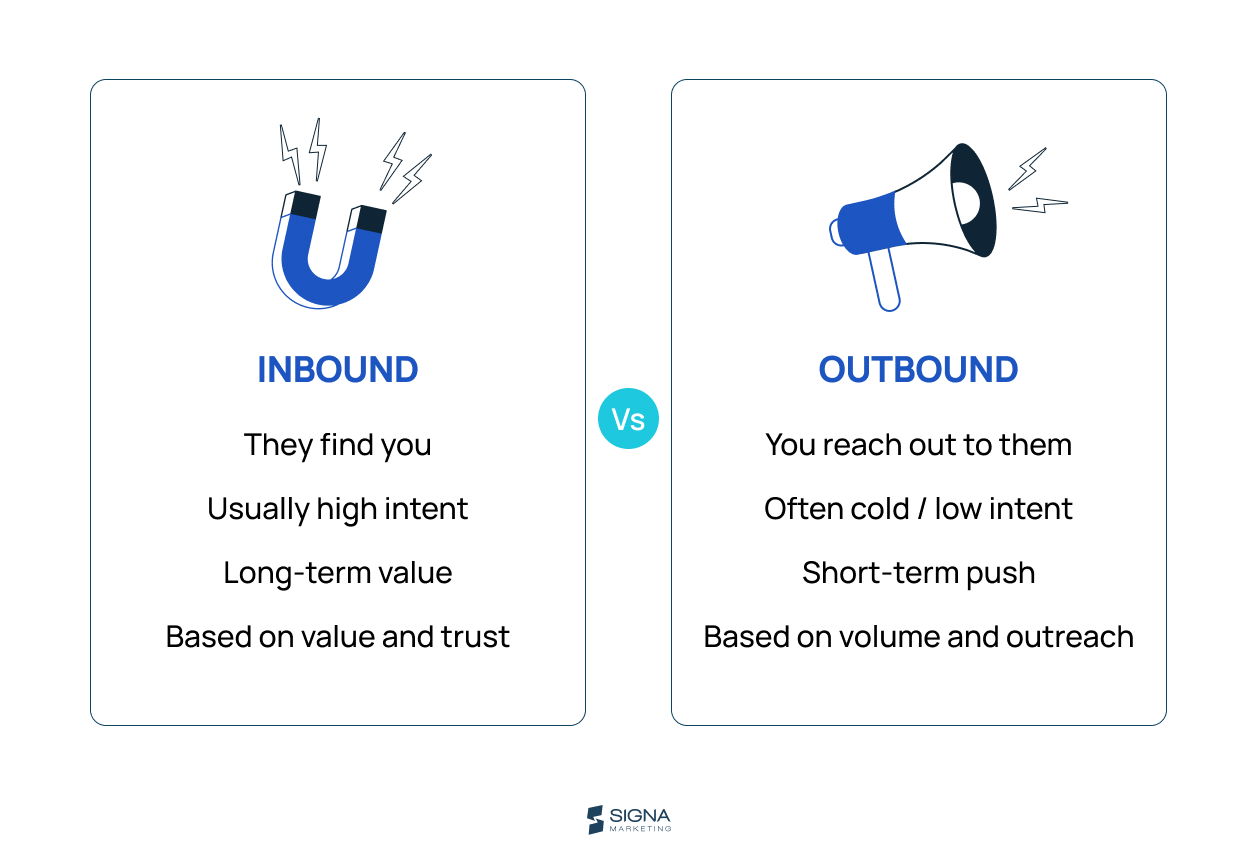
Inbound starts with prospects choosing to engage after finding relevant information or a solution. Outbound starts with the business initiating contact, such as cold calls or unsolicited prospecting emails. Both can contribute to growth; inbound leads are not automatically more qualified or less expensive.
Paid media can support an inbound strategy by promoting useful resources and connecting existing demand to relevant landing pages. Record the acquisition source separately from the prospect’s response: a paid-search inquiry, a paid-social resource signup, and a response to cold outreachFor example, a business using outbound marketing might contact potential customers through cold emails or sales calls. With inbound marketing, that same business could publish a helpful guide answering a common customer question. When someone discovers the guide through search, finds it useful, and requests more information, they become an inbound lead.
The key difference is how the relationship begins. Outbound marketing initiates the conversation, while inbound marketing creates opportunities for prospects to engage when they are ready. Both approaches can be effective, but inbound focuses on attracting people who are already researching a problem or exploring solutions. can all be voluntary, but they began through different approaches. Responding to an outbound campaign does not automatically make a lead inbound. Evaluate source, fit, and intent together.
How Inbound Lead Generation Works
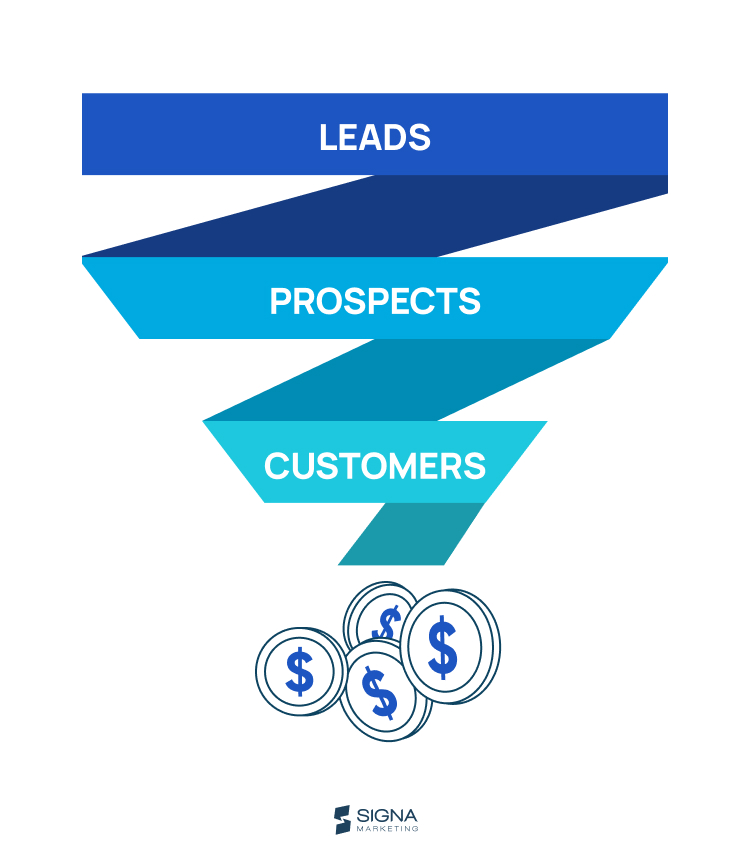
The practical sequence is to attract, capture, qualify, and follow up. Prospects may revisit earlier stages or use several channels, so treat this as a working process rather than a rigid path. HubSpot’s explanation of inbound marketing provides broader context for attracting and engaging an audience.
The process succeeds when each stage answers a customer question: can you help me, why should I trust you, what should I do next, and what happens after I reach out?
How to Create an Inbound Marketing Strategy: A Step-by-Step Plan
1. Set Business Goals and Define the Ideal Client
Choose a measurable outcome and timeframe: qualified consultations, sales opportunities, or new clients. Use your baseline close rate and capacity to estimate the required lead volume. Define the service needs, geography, budget range, and client characteristics the strategy should attract.
Work backward through the funnel. If the goal is five new clients, 25% of opportunities become clients, and 50% of qualified leads become opportunities, the plan requires 20 opportunities and 40 qualified leads. If half of all captured leads qualify, that means approximately 80 initial leads. Use your own stage conversion rates and allow time for leads to progress; these figures illustrate the calculation.
2. Audit the Journey and Find the Main Bottleneck
Map discovery, evaluation, inquiry, qualification, follow-up, and sale. Review traffic relevance, service-page performance, form completion, call outcomes, response speed, and lost-opportunity reasons. Identify the stage that most limits results before adding campaigns.
A busy website with few qualified inquiries may need a clearer offer or better audience targeting. A strong inquiry flow with missed calls may need operational fixes before more media spend.
3. Choose Channels and Allocate Resources
Prioritize according to demand, urgency, sales cycle, and available staff.
For example:
- Existing high-intent search demand may justify SEO and paid search.
- A service requiring education may benefit from content, organic social, and selective paid promotion.
- A local provider may need stronger map visibility and reviews first.
Set a test budget using fully defined acquisition costs. Suppose the total allowable client acquisition cost is $1,000 and 20% of qualified leads become clients. That allows $200 in total acquisition spending per qualified lead. If agency fees, content, technology, and sales effort account for $75 per qualified lead, the remaining media allowance is $125—not $200.
Use a consistent period and cost allocation, account for shared costs without double-counting, and distinguish media cost per qualified lead from total acquisition cost. Base the limit on service margins, cash flow, and actual close rates, then revise it as evidence improves.
4. Align Content and Offers With Each Stage
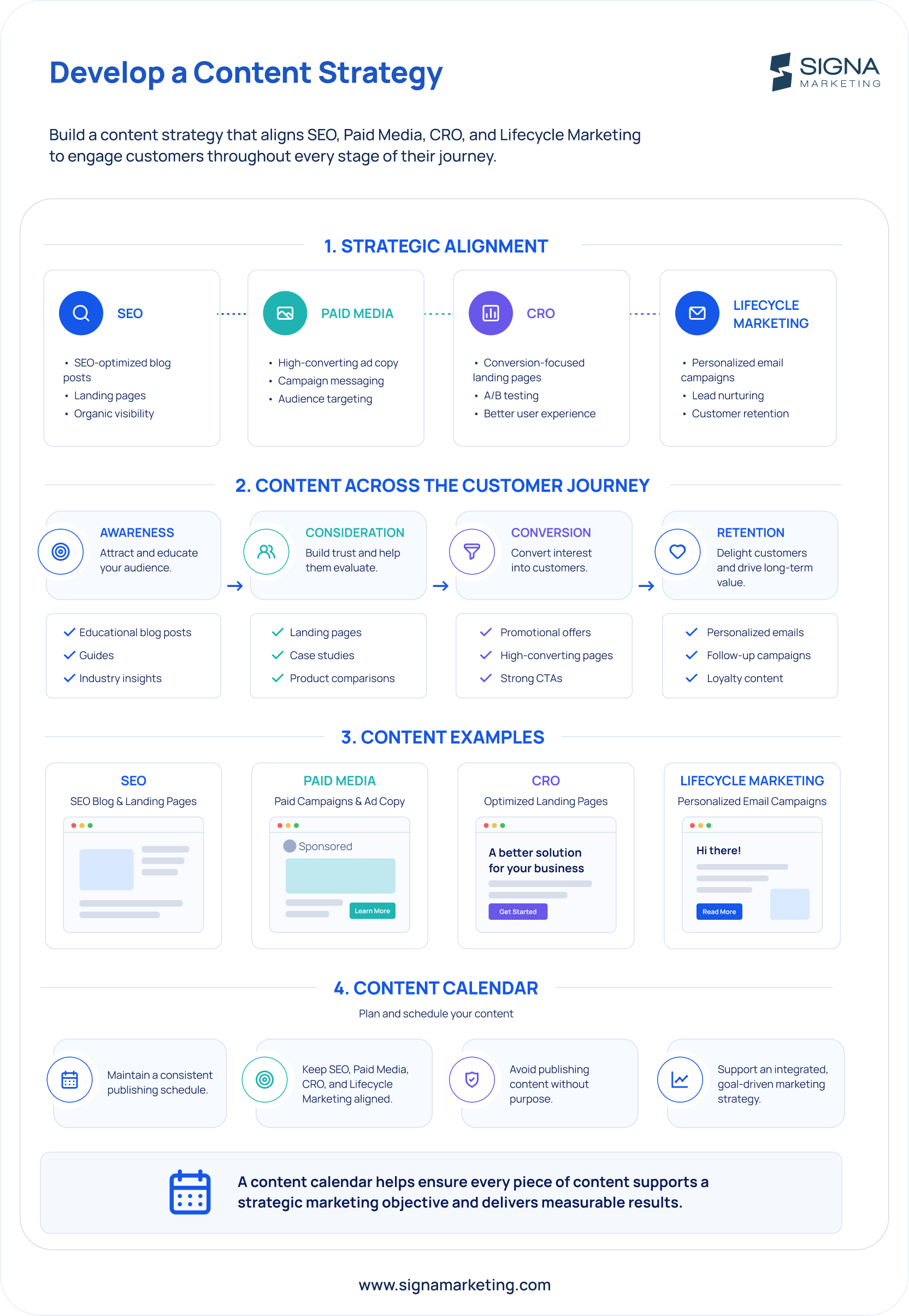
Build the missing assets around your priority service: a useful educational resource, an evaluation page with evidence, and a clear inquiry path. Use lead magnets where the value justifies contact capture; keep core explanations and service details freely accessible.
Publish a case study that identifies the challenge, changes, and observed outcome. In Signa’s real estate lead generation case study, the work included SEO, PPC, a website redesign, and two landing pages. The published case reports increased website traffic and lead conversions, showing how acquisition and the website inquiry experience can support the same business goal.
5. Connect Technology and Assign Ownership
Connect forms, call tracking, analytics, advertising platforms, and the CRM so lead sources and outcomes can be reviewed together. HubSpot or another CRM can manage contacts and follow-up; analytics and search tools support acquisition analysis. Choose tools based on the workflow rather than building a complicated stack first.
Assign owners for publishing, campaign management, inquiry response, qualification, and reporting. Test a complete submission and handoff before launch, including confirmation messages, notifications, source capture, and the CRM record.
6. Launch, Review, and Adjust
Launch around the priority audience, offer, and conversion path. Review delivery and lead handling frequently enough to catch problems early; evaluate opportunity and revenue trends over a period that reflects the sales cycle. Record what changed and why before expanding the strategy.
Before launch, confirm:
- The audience, service, and offer are clearly defined.
- Calls, forms, confirmations, and CRM routing work.
- Tracking captures the acquisition source and requested service.
- Follow-up has an owner and an agreed response window.
- Qualification criteria and reporting stages are consistent.
- Reporting connects leads to opportunities and clients.
The Four Core Components of an Inbound Strategy
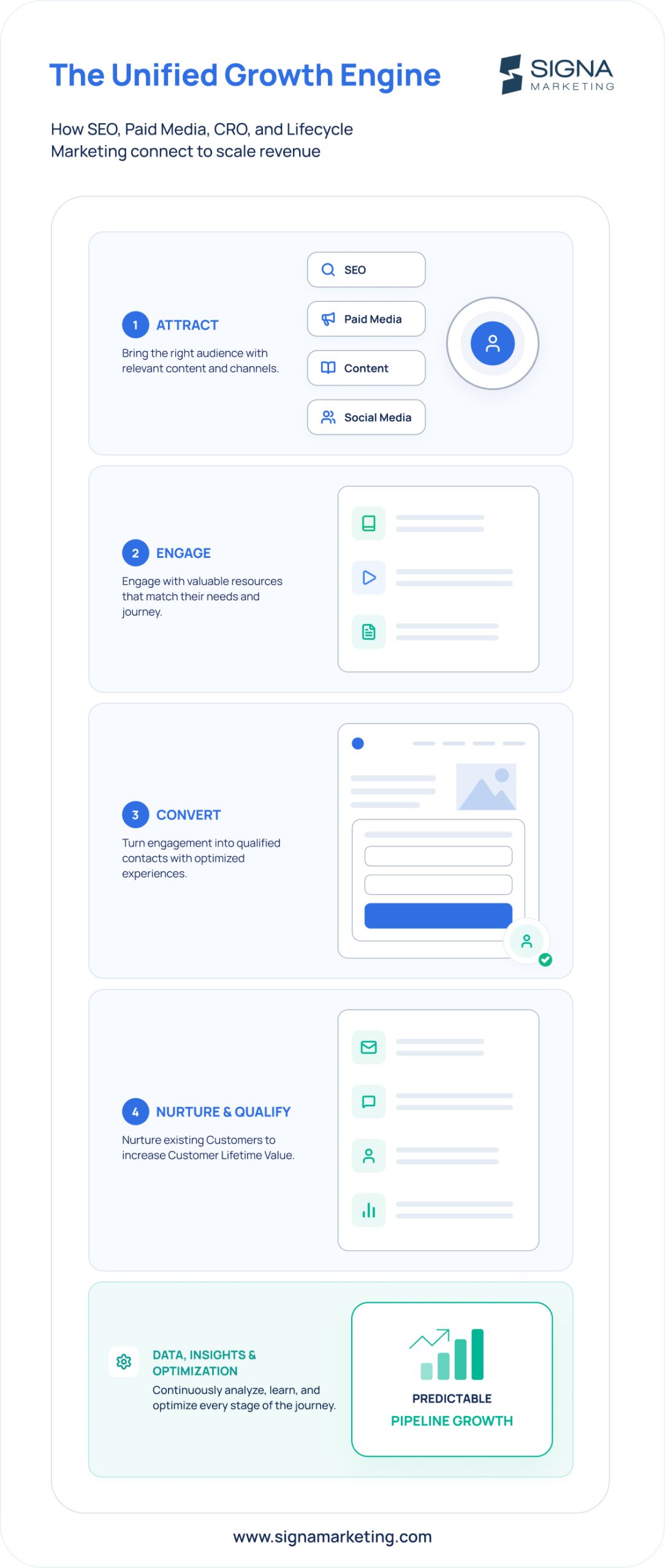
At Signa, four connected components guide the strategy: Brand Foundation, Traffic Acquisition, Conversion, and Lifecycle Marketing. For lead generation, each has a specific job.
Brand Foundation
Define your ideal client, service-area or industry requirements, the problem you solve, and the reasons to choose your business. Carry that positioning across search content, ads, social posts, service pages, emails, and sales conversations. Describe the service and its value clearly enough that suitable prospects can recognize themselves in the message.
Traffic Acquisition
SEO, paid media, organic social, and referrals help prospective clients discover your expertise. Search can capture demand for a service; social content can demonstrate expertise and answer questions; paid distribution can extend reach. Choose channels based on audience fit and the role they play in generating qualified inquiries.
Conversion
Give visitors a relevant reason to provide contact information or request help. Lead capture might involve a resource download, assessment, phone call, estimate form, or consultation booking. Separate educational signups from service inquiries so reporting and follow-up reflect their different levels of intent.
Lifecycle Marketing
Within a lead generation strategy, lifecycle marketing nurtures prospects and supports the transition to a customer. Relevant education, inquiry acknowledgments, appointment reminders, and proposal follow-up help leads progress without treating every contact as ready for sales.
Search Visibility: Get Found in Search and AI
Understand Search Intent and Your Audience
Build keyword research around the questions clients ask, the services they need, and the language they use. “How much does a commercial energy audit cost?” may need an explanatory guide. “Commercial energy audit provider” may need a service page with qualifications, process details, and an inquiry path.
Group searches by intent, then choose pages and offers that answer the actual question. Ahrefs or Semrush can support research, but sales conversations and customer questions help identify which topics attract suitable prospects. Our SEO services connect that visibility to relevant conversion opportunities.
Build the SEO Foundation
Make important service, industry, location, and resource pages accessible to search engines and visitors. Review crawlability, indexing, page titles, headings, internal links, mobile usability, and loading performance. Organize the site so prospects can move from a question to the relevant service and supporting proof.
For eligible local service businesses, maintain an accurate Google Business Profile, relevant service-area information, and a process for requesting genuine reviews. Connect local visibility to useful location pages and accessible call or booking options. Measure qualified calls and appointments rather than treating every profile interaction as a lead.
Create Content That Supports the Buyer Journey
Prioritize questions that influence service selection: cost, scope, process, suitability, alternatives, and common risks. Educational articles help prospects understand a problem. Comparisons and case studies help them evaluate providers. Service pages explain delivery, proof, and the next step.
Use firsthand expertise rather than repeating general advice. Include an explanation from someone who delivers the service, an anonymized customer question, or a documented project example. Link related content to the relevant offer; avoid sending every reader to a generic contact page.
Optimize for AI and Answer Engines
SEO, answer engine optimization (AEO), and generative engine optimization (GEO) concern visibility across evolving research experiences. Clear answers, credible evidence, and accessible pages provide a useful foundation, but practices and reporting vary by platform.
Google’s official AI search guidance confirms that SEO fundamentals remain relevant to Google’s generative Search features. That guidance applies to Google Search; it does not establish requirements for every AI assistant or guarantee inclusion. Evaluate visibility alongside referral traffic and qualified inquiries where those signals are available.
Paid Media: Accelerate Demand and Reach
Paid Search
Paid search can reach people actively looking for a service. Align the search query, ad, and landing page around the same need. A campaign for emergency repair should lead to an appropriate service and contact experience, while an advisory campaign may need more evidence and a consultation offer.
Control irrelevant demand through geographic targeting, search-term review, exclusions, and clear service messaging. Our paid search approach focuses on connecting relevant searches to a practical path to inquiry.
Paid Social
Paid social can introduce your expertise, promote a useful assessment, or re-engage prospects. LinkedIn may suit B2B services with role or industry targeting. Meta, TikTok, and other platforms should be selected when the audience, creative, offer, and economics justify the investment.
A low-cost guide download is not equivalent to a consultation request. Compare campaigns using qualification and downstream outcomes, and match follow-up to the offer the person chose.
Retargeting and Remarketing
Where permitted and supported, use remarketing to address the next question a prospect is likely to have. An educational reader may need a relevant case study; someone evaluating a service may need process details or a consultation invitation. Exclude converted leads where appropriate and avoid repetitive messages that ignore their stage.
Measure Paid Media Beyond Clicks
Track cost per qualified lead, booked and attended consultations, opportunities, acquisition cost, and revenue. Feed accepted and rejected lead outcomes back into campaign decisions. High form volume with poor fit can indicate a targeting or offer problem rather than successful acquisition.
Conversion Rate Optimization: Turn Traffic Into Qualified Leads
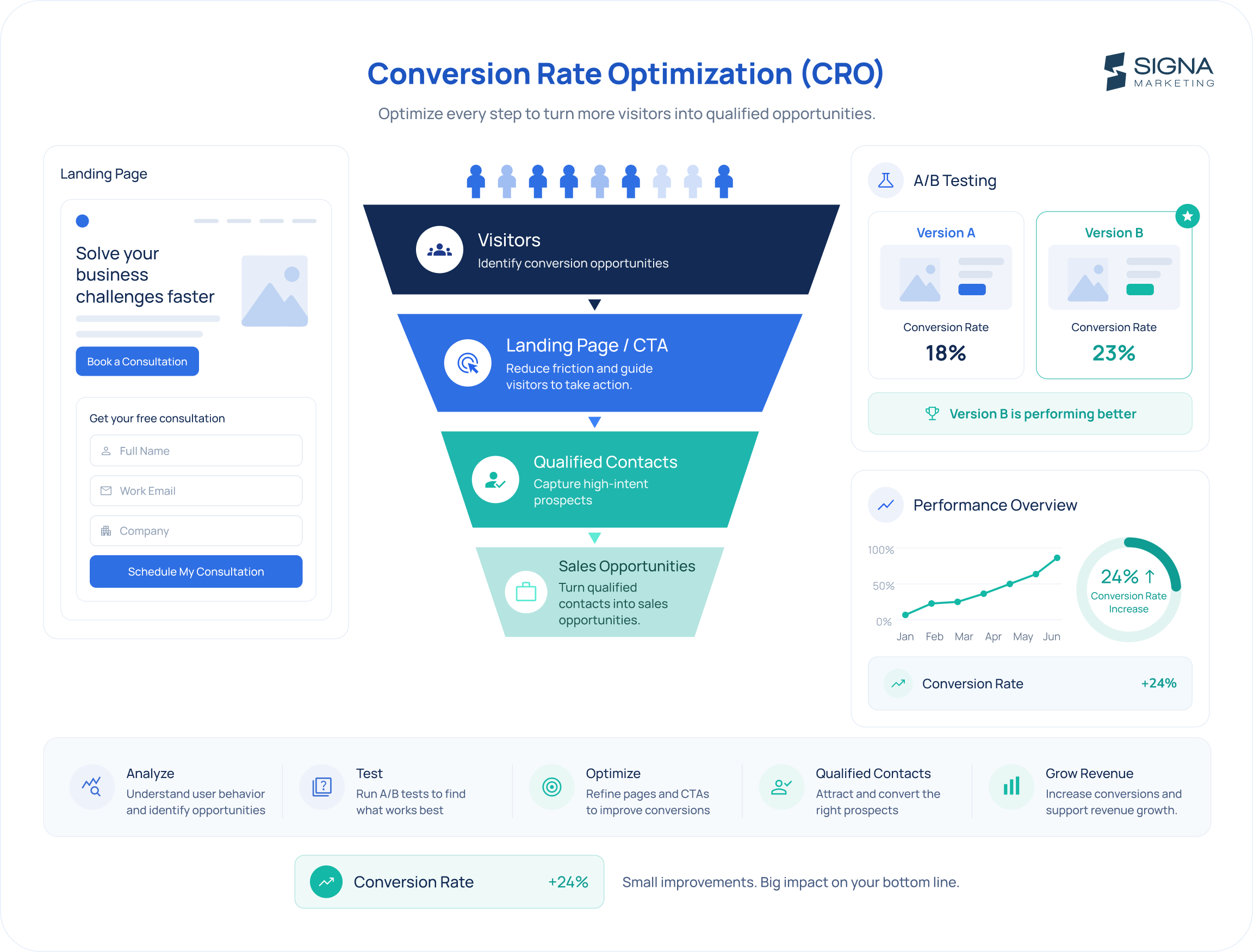
Define the Right Conversion and Offer
Match the offer to readiness. An educational checklist can capture early interest; an assessment can reveal the scope of a problem; an estimate or consultation request can capture more immediate service intent. Keep essential service information accessible so visitors can evaluate you before sharing their details.
Specify what each offer delivers and what happens next. If a download triggers marketing follow-up, communicate that clearly. Ask for enough information to support routing and qualification without collecting fields that serve no practical purpose.
Create Clear Conversion Paths
A service landing page should explain who the service is for, the problem it addresses, the delivery process, relevant proof, and the next step. Match the primary CTA to the page’s intent, and provide a useful secondary option when readers need more information.
Make calls and forms easy to use on mobile. Confirm successful submission, set expectations for a response, and test that the inquiry reaches the correct person or CRM workflow.
Reduce Friction and Build Trust
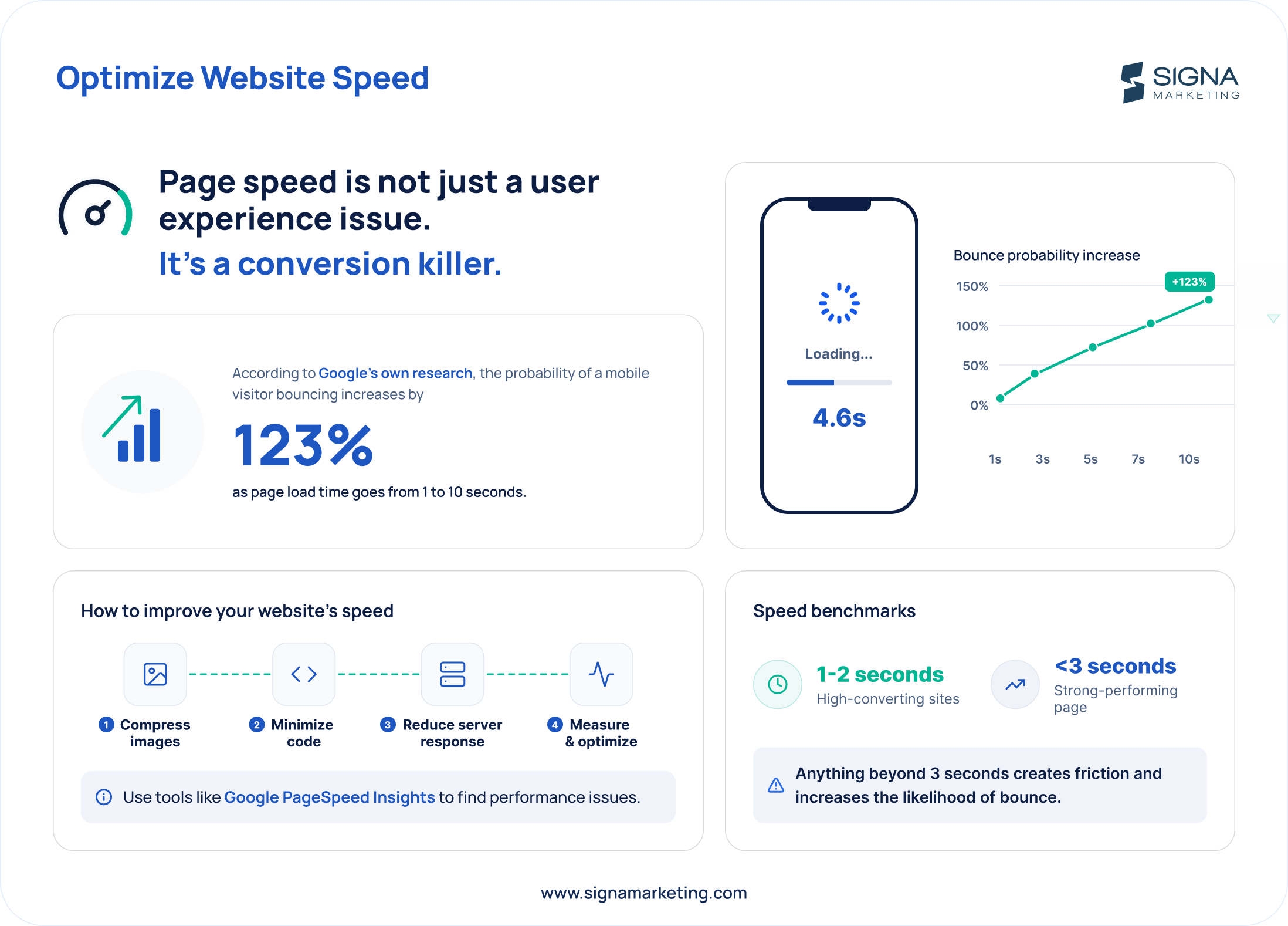
Fix broken forms, slow pages, confusing navigation, and inaccessible controls. Also address missing information: prospects may hesitate because scope, pricing approach, location coverage, qualifications, or the consultation process is unclear.
Use relevant testimonials, certifications, reviews, and case studies to reduce uncertainty. Present results with their context and avoid implying that every client will achieve the same outcome.
Test and Optimize
Begin with a hypothesis tied to a specific obstacle. Use funnel analysis, form data, customer interviews, usability testing, and session recordings where appropriate to understand the problem.
Run A/B tests when traffic and conversion volume support a meaningful comparison. For lower-volume service sites, prioritize clear functionality fixes and qualitative research, then monitor lead quality and conversion trends. A short before-and-after improvement alone does not establish that a change caused the result.
Lifecycle Marketing: Nurture and Qualify Inbound Leads
Capture and Use First-Party Data
Store relevant contact details, inquiry source, service interest, and follow-up permissions in your CRM. Keep records usable through deduplication, spam filtering, and consistent fields. Collect information that improves the experience or qualification process rather than adding fields simply because the technology allows it.
Segment Your Audience
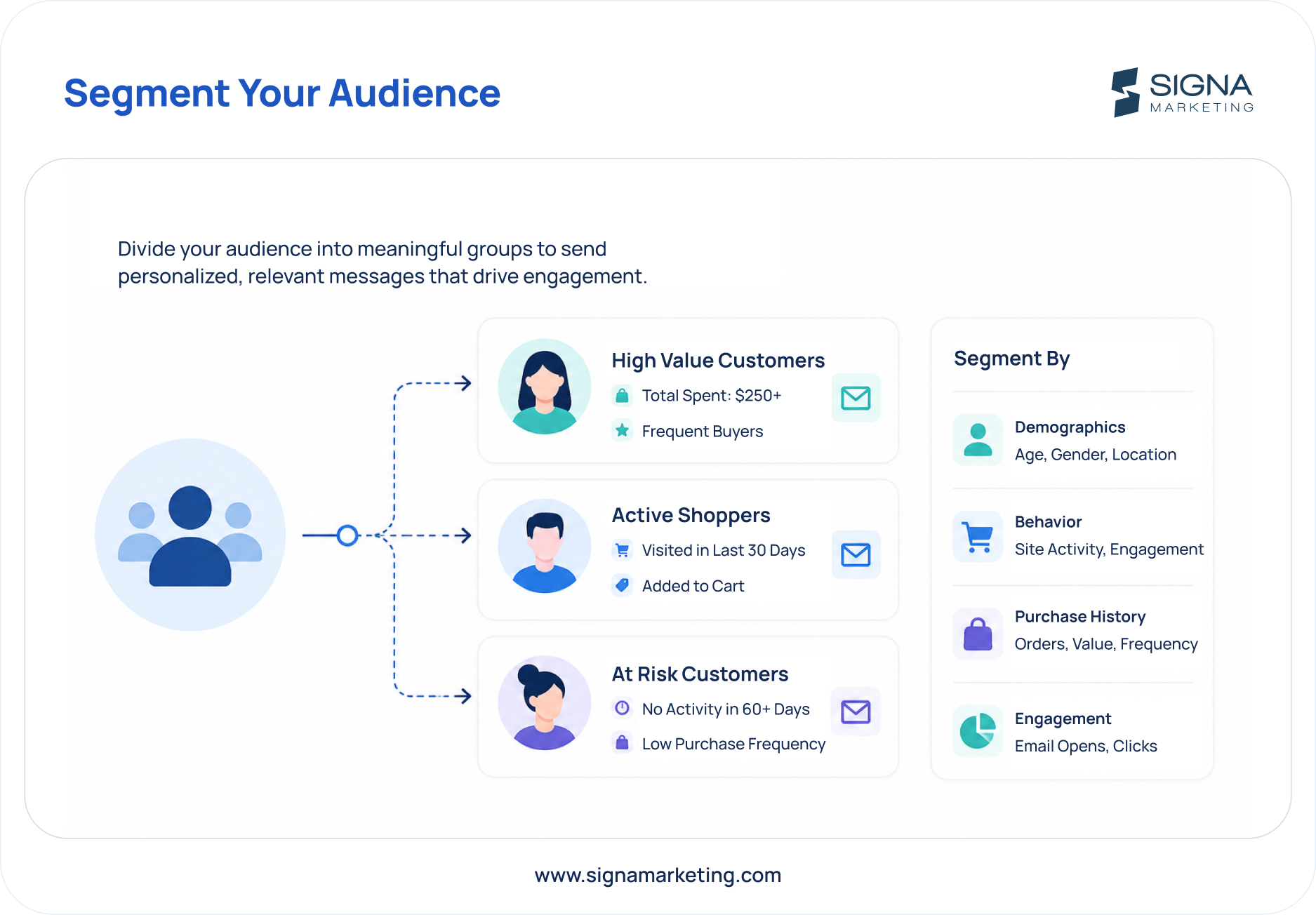
Separate resource subscribers, active service inquiries, proposal-stage prospects, and contacts whose timing is uncertain. Further segment by service need, location, industry, or company size when those differences should change the message. An unanswered estimate request needs a different response from a first-time guide download.
Automate Relevant Follow-Up
Acknowledge inquiries, deliver the requested resource, notify the responsible person, and guide prospects toward an appropriate next step. Set response expectations based on urgency and staffing. A direct request for service should receive prompt human attention rather than waiting through an educational sequence.
For example, an advisory firm could nurture a planning-checklist lead through this sequence:
- Deliver the checklist immediately and explain what follow-up to expect.
- Share a practical explanation of the planning issue the resource addresses.
- Ask about the prospect’s main challenge or project timing to understand fit and intent.
- Invite suitable prospects to a consultation when their responses or actions indicate interest.
A direct consultation request should bypass that educational sequence and go to the responsible person. Pause overlapping nurture when a sales conversation begins, and let prospects manage their preferences.
Qualify Leads and Align Marketing With Sales
Evaluate fit and intent separately. Fit includes service need, location, industry, and operational requirements. Intent includes a specific request, project timing, and willingness to discuss next steps. Budget compatibility and decision-making involvement help shape the conversation, but missing information does not automatically mean a poor-fit prospect.
Distinguish unsuitable leads from suitable prospects whose timing or readiness is uncertain. A lead outside your service area may be disqualified; a relevant prospect researching next year’s project may belong in nurture. Record whether a lead is unsuitable, not yet ready, or ready for sales, and revisit that status when new information becomes available.
Lead scoring can help prioritize follow-up, but a pricing-page visit or email interaction is not proof of readiness. Treat behavioral signals as supporting context. Establish disqualifying criteria, such as unsupported locations or services, and let sales validate opportunities rather than relying on an automated score alone.
Agree on the qualification criteria, owner, response window, CRM fields, and handoff process. Track whether each lead was contacted, accepted, booked, converted, or rejected—and why. This feedback helps marketing improve targeting and offers while revealing follow-up gaps that campaigns cannot fix alone.
How to Measure Inbound Lead Generation Performance
Measure the Entire Funnel
Follow the progression from relevant visits to identifiable leads, qualified inquiries, appointments, opportunities, and clients. Define each stage consistently and separate resource signups from service requests. For local providers, review call outcomes and attended appointments; for B2B services, review sales acceptance and opportunity progression.
Define the denominator and cost scope for each metric:
- Lead capture rate: new captured leads divided by visits to the relevant capture pages, multiplied by 100. Use a consistent visitor or session basis.
- Qualification rate: qualified leads divided by captured leads in the same acquisition cohort, multiplied by 100. State how pending qualification is handled.
- Media cost per qualified lead: attributable advertising spend divided by qualified leads generated by that spend. Report fully loaded costs separately.
- Appointment attendance rate: attended appointments divided by appointments scheduled to occur during the measured period, multiplied by 100. State the cancellation policy.
- Qualified-lead-to-opportunity rate: opportunities divided by qualified leads in the same cohort, multiplied by 100.
- Opportunity close rate: new clients divided by opportunities in the same cohort, multiplied by 100.
- Client acquisition cost: defined marketing and sales acquisition costs divided by new clients, using a consistent period or allocation method.
Compare leads acquired in the same period and allow enough time for their outcomes to mature. Track pending outcomes separately so a longer sales cycle does not appear to be a failed campaign.
Connect Lead Quality to Acquisition Economics
Lead volume and revenue alone do not show profitability. Evaluate service delivery costs, sales effort, gross profit or contribution margin, and acquisition payback. A lower-cost lead source can be less valuable if it produces poor-fit clients or work the business cannot serve profitably.
For recurring services, use realistic customer value and payback assumptions to inform acquisition limits. Separate observed results from projected future revenue.
Understand Attribution and Incremental Impact
Attribution distributes credit among recorded marketing interactions. Last-click reporting can overlook earlier research, but no model records every influence. Combine analytics with CRM outcomes, call data, and prospect-reported discovery information rather than treating one report as complete.
Attribution does not prove that marketing caused additional sales. Where scale and budget allow, holdout or geographic experiments can help evaluate incremental impact. For smaller programs, interpret trends cautiously and account for seasonality, sales execution, and other changes.
For a practical next step, use Signa’s Attribution Playbook to review the clarity of your channel reporting before making budget decisions.
How Inbound Lead Generation Is Changing
Discovery Across AI, Social, and Video
Prospects can research questions and compare providers through AI tools, social platforms, and video. Make service expertise and evidence clear wherever your audience evaluates options. AI can assist content and analysis workflows, but review factual accuracy and qualification decisions before relying on its output.
Use organic social and video to answer questions clients ask before contacting you. Demonstrations, expert explanations, and project walkthroughs can support evaluation. Link to a relevant resource or inquiry path and judge effectiveness by qualified engagement rather than views alone.
First-Party Relationships and Interactive Content
Give prospects a transparent reason to share information. A service assessment or cost calculator can help clarify need while capturing useful qualification details. Offer meaningful value, explain follow-up, and avoid requiring unnecessary personal information to access basic answers.
From Inbound Strategy to Qualified Opportunities
A stronger inbound lead generation strategy makes the path from discovery to qualified inquiry easier to follow and easier to improve. Clear positioning, relevant acquisition channels, useful offers, and accountable follow-up work together to support that path.
Review performance against demand, competition, budget, offer strength, and service capacity. Use what you learn to improve the stage that most limits qualified opportunities.
Ready to Build an Inbound Lead Generation Strategy That Drives Measurable Growth?
Where is your lead generation process losing suitable prospects: discovery, inquiry, qualification, or follow-up? Signa Marketing helps service-based businesses build integrated inbound strategies that connect those stages. Book a strategy call to discuss your current results, identify the biggest bottleneck, and determine which improvement deserves attention first.
Frequently Asked Questions About Inbound Lead Generation
It is a plan for attracting relevant prospects, capturing their contact information or inquiries, qualifying their needs, and guiding suitable leads toward a service engagement. It connects acquisition, conversion, nurturing, and sales follow-up.
Choose a resource that helps your ideal client solve a relevant problem or evaluate a service need. A checklist, assessment, or calculator should connect naturally to your service and provide enough value to justify sharing contact details. Measure qualification and progression, not downloads alone.
Review rejection reasons before changing campaigns. Check whether targeting, search terms, geography, service messaging, or the offer is attracting unsuitable prospects. Separate poor fit from uncertain timing, then adjust acquisition or nurture accordingly. Also verify that slow follow-up or incomplete CRM records are not distorting the assessment.
Start with the limiting stage. If suitable prospects rarely find you, strengthen acquisition through the channels that fit existing demand. If relevant visitors arrive but rarely inquire, review the offer and conversion experience. If suitable leads fail to progress, fix qualification or follow-up before increasing traffic.
Begin with a shared CRM, clear lead stages, an assigned follow-up owner, and a defined response process. Capture the requested service and source, record outcomes, and automate acknowledgments or resource delivery. Add scoring and more complex workflows only when volume and the sales process justify them.
Track identifiable leads, qualified inquiries, booked and attended appointments, opportunities, lead-to-client conversion, cost per qualified lead, client acquisition cost, and revenue. Connect those outcomes to acquisition sources and profitability.
Timing depends on existing visibility, demand, budget, website performance, and the sales cycle. Paid campaigns can provide early acquisition feedback, while SEO and nurture need time to develop. Evaluate lead quality first, then opportunities and revenue as those leads progress.
You may also like
